
 Esperanto
 Shqiptare
 Euskara
 Zulu
Zulu
 Latinus
 Cymraeg
 தமிழ்
தமிழ்
 Slovak
 Slovak
 Afrikaans

 +8617661668329
 NEWS
Sliced veneer manufacturing process
2022-09-19
Usually, natural veneer is processed by slicing. The process flow is as follows:
Log → truncation → sectioning → softening (steaming or boiling) → slicing → drying (or not drying) → shearing → inspection and packaging → storage
The following only introduces three important aspects:
1. Sectioning
After the log enters the factory, it must be cut into wood segments according to the required length, and then when the wood is cut, the sawing plan must be selected according to the diameter of the log, the texture of the wood and the fixing method of the wood on the planer, so that the thin wood is cut. The width is not less than the relevant requirements.
A reasonable plan not only has a high yield, but also produces more veneers in diameter cuts and less veneers in string cuts, and the resulting products have high decorative value. Logs of different diameter grades require different sawing schemes. The thick solid line in the figure is the saw section line, and the direction of the arrow is the cutting direction of the planer:
In actual production, sawing plan B is usually used for logs with a diameter of less than 400mm, while sawing D and E are used for logs with a diameter of 400~800mm. When veneer is produced by these sawing and slicing schemes, the board yield is high, the veneer quality is better, and the slicer efficiency is higher.
2. Steaming
After the wood is cooked (ie hydrothermal treatment), the plasticity of the wood increases. An effective way to improve the plasticity of wood is to adjust the two factors of temperature and moisture content at the same time, that is, to increase the temperature of the wood and increase the moisture content of the wood at the same time. This is the reason why the wood is usually cooked with saturated steam or hot water in actual production—hydrothermal treatment.
When the wood is put into the cooking tank, it should be carried out according to the tree species and the specifications of the wood. When the temperature rises to above 40°C, the heating rate should be slowed down; excessive cooking will also reduce the quality of veneer; the cooking tank should be frequently cleaned of resin, bark, and sediment, and the water should be changed frequently to reduce wood pollution; after cooking The wood should be put into the warm water tank for wood storage in front of the slicer in time, 3. Dry
The moisture content after drying is generally required to be 8% to 12%. The veneer drying equipment includes a drum dryer and belt dryer for continuous operation and a drying room for intermittent operation. The drying room is an old-fashioned drying equipment, which is very uneconomical, but the drying quality is better. The most widely used is the tumble dryer. For thin veneers, especially those with a thickness of less than 0.4mm, a belt dryer must be used.
4, veneer cutting method
Cross-cut: vortex; Longitudinal: straight; Oblique: mountain


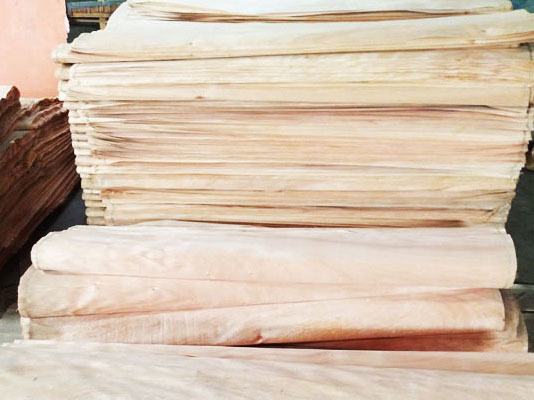

Is located in the logistics city of Shandong Province - Linyi City, Yitang Town Industrial Park is an international wood industry company integrating production, sales, processing and trade.
CONTACT US
 +8617661668329
 +8617661668329
 monica@sdyzwood.com
 Yitang Industrial Park, Yitang Town, Lanshan District, Linyi City, Shandong Province

Copyright © 2022 Shandong Yuanzuo All Rights Reserved. Powered by www.300.cn SEO